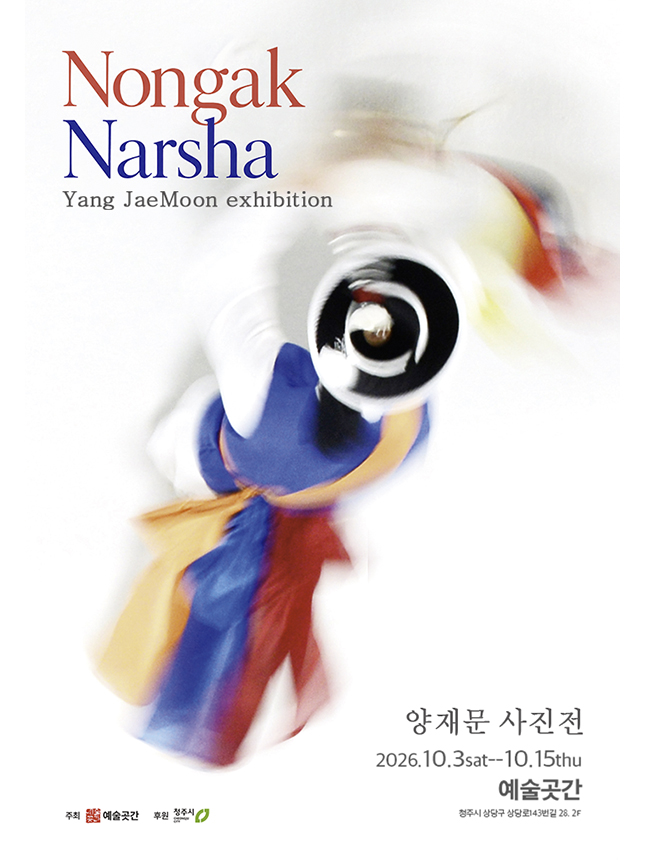
Nongak Narsha
전시기간: 2026.10.3~10.15
전시장소: 예술곳간
충청북도 청주시 상당구 상당로143번길 28 2층
Daedong Nongak (大同農樂)
A Narrative for the Age of the Commons
Ahn Hyun-jung(Art Critic, PhD in Philosophy of Art)
Yang Jae-moon’s Cheoyong and Nongak series share a common ground: both recover traditional values as a means of healing an age marked by loss. If Cheoyong embodies tolerance bestowed from above-a capaciousness of spirit that embraces rather than excludes-Nongak rises from below, from the heung and meot of ordinary people: an exuberant vitality and an unforced elegance born from life itself. Because Nongak emerges from the primal gestures of the body and from an order that appears almost ruleless, it allows Yang a degree of artistic freedom rarely encountered in his earlier work.
Why, then, does the artist summon Nongak as a metaphor for the spirit of our time?
Traditionally performed by farming communities organized around dure, collective labor groups in rural villages, Nongak brings together music, dance, play, ritual, and communal solidarity. Its sound is led by percussion-the piercing kkwaenggwari, resonant gong, janggu, and barrel drum-and its energy arises less from predetermined choreography than from the intuitive pulse of the moment. Improvisation, bodily response, and collective rhythm generate its distinctive vitality.
This distinguishes Nongak sharply from Yang’s earlier exploration of Cheoyongmu. When photographing Cheoyong dance, whose movements unfold within a solemn cosmological order associated with the yin-yang and Five Elements, the artist responded to the tension, decorum, and ceremonial gravity of court music. Nongak releases him from such discipline. Direction dissolves; linear logic loosens. What emerges instead is the freedom of orchestration itself..
In this sense, the Nongak series marks a culminating passage in Yang’s long exploration of Korean traditional dance under the title The Korean Odyssey. It approaches the condition of a visual epic written through the moving body. Following the dreamlike transcendence of his Bicheonmong series, Nongak opens onto a more lucid and expansive realm of heung: a collective exhilaration through which people historically endured hardship not by denying pain, but by transforming it into rhythm, laughter, movement, and sinmyeong-the heightened vitality of communal release.
Significantly, when Yang works with large-scale choreographic subjects such as Nongak and Cheoyongmu, female dancers no longer occupy the central image. The change alters more than the cast of figures. The sensual lyricism of the individual body recedes, allowing larger historical and collective movements to enter the photographic field. What unfolds before us is less a portrait of particular performers than the movement of an era-the surge, collision, dispersion, and reunion of human beings within a shared space.
For the first time in this series, Yang employs an elevated, downward-looking perspective. Yet this bird’s-eye view operates as more than a device for surveying the scene from above. In the East Asian tradition of spatial perception, such a viewpoint can evoke not only physical distance but also the emotional depth of simwon (深遠), the “deep distance” through which the visible world opens toward an inward abyss. Yang’s Nongak landscapes consequently hover between event and memory. Figures gather and scatter across fields of emptiness; movement draws temporary constellations upon the surface, while the surrounding void allows each gesture to resonate beyond itself.
The freedom generated by these spacious compositions ultimately converges in what may be called an aesthetics of Daedong (大同)-the ideal of a world held in common.
Here, the Five Cardinal Colors do more than enliven the photographic surface. They circulate wishes for well-being among bodies in motion. Color becomes something shared, just as rhythm is shared and breath is shared. Nongak gathers wounded hearts into a single open ground, binding one person to another without erasing difference. Historically rooted in the lives of ordinary people rather than social elites, it carries the memory of those who rarely occupied the center of official history. Yang transforms that memory into an ethics of coexistence.
His Nongak series thus embraces what Zhuangzian thought might call “the usefulness of the useless” (無用之用). Nongak produces nothing that can easily be measured as material profit. Its value lies elsewhere-in gathering people, suspending ordinary hierarchies, releasing accumulated sorrow, and restoring the sensory bonds of a community. Its apparent lack of plan contains another kind of order: a plan within planlessness, an intelligence generated through bodies listening and responding to one another.
Perhaps Nongak is precisely this: a dance performed by those who possess the paradoxical capacity to turn ordinary life into art.
Human beings cannot inhabit the world alone. We live by meeting, touching, answering, and forming relations with others. Daedong names the force that connects separate lives without reducing them to sameness. Yang discovers freedom in Nongak because it once helped villagers create, however briefly, a world in which living together could itself become an art. Beneath the exhilaration of the images lies a quiet desire for such a society-a community sustained by attention and care, mutual recognition, affection, and the willingness to share a world.
One is reminded of the phrase 儉而不陋 華而不侈 (geom-i bulru, hwa-i bulchi): “frugal without appearing shabby, splendid without becoming extravagant.” This equilibrium illuminates the aesthetic character of Nongak. Its beauty comes neither from luxury nor calculated refinement. It arises from an artfulness that conceals artifice-a virtuosity without ostentation, a choreography that seems to emerge by itself, and a humor capacious enough to include everyone.
What Yang Jae-moon discovers in Nongak, therefore, extends beyond the preservation of tradition. Tradition here is neither nostalgia nor spectacle. It is a living social intelligence. It teaches how sorrow might pass into exhilaration, how separate bodies might enter a common rhythm, and how freedom might arise not from isolation but from being together.
At a moment when contemporary life repeatedly fragments individuals into solitary units, Yang’s Daedong Nongak returns us to an older yet urgently contemporary proposition: a shared world begins when one body answers the rhythm of another.
In that sense, Nongak is not simply an image of Korea’s past. It is a choreography for the future-a visual narrative of how we might once again inhabit the world in common.
대동농악(大同農樂), 공유 시대의 서사
안현정(미술평론가, 예술철학박사)양재문 작가의 작업 처용과 농악은 상실의 시대를 치유하는 ‘전통가치’라는 측면에서 일맥상통한 시리즈이다. 처용이 위로부터의 관용(너른 마음)이라면, 농악은 아래로부터의 흥과 멋이라고 할 수 있다. 인간 본연의 몸짓과 규칙 없는 무규칙의 행위인 까닭에 ‘기존 작품세계’보다 자유로운 작가정신을 녹아 있는 것이다. 작가가 오늘의 시대정신에 농악을 대입한 까닭은 무엇일까. 농악은 농촌에서 농부들이 두레를 짜서 일을 할 때 주로 하던 연행음악으로 춤과 놀이 그리고 공동체 정신이 결합된 한국의 대표적인 전통문화이다. 꽹과리·징·장구·북과 같은 타악기가 주류를 이뤄 그때그때의 ‘직관적 흥’을 주재료로 삼는다.
양재문 작가는 ‘처용(태극의 음양오행론에 따른 엄숙한 구조를 따르는 춤)’을 진행할 때는 ‘궁중음악에 맞는 긴장감과 격식’에 따랐다면, 농악은 무 방향 / 무 논리에 따른 ‘연출의 자유’를 누렸다. 그 동안 한국의 전통춤으로 추구해온 작가의 더 코리안 오딧세이(The Korean Odyssey)의 결정판인 '농악'시리즈는 전통춤을 가지고 쓴, 전통 서사시의 완결편인 셈이다. 시대적 난관을 신명나는 춤으로 극복한 농악을 향한 입체적 방식은 《비천몽》 시리즈 이후 펼쳐낸 명쾌한 흥취라고 할 수 있다. (농악과 처용무와 같이 큰 연출이 필요한 작품을 표현할 때, 작가는 여성 춤꾼들을 등장시키지 않는다. 그래서일까. 일반적 관점이 아닌 ‘시대의 큰 움직임’들이 작품에 펼쳐져 있다.)
작가는 이번 시리즈에서 기존 춤사진과 달리 처음으로 부감시(俯瞰視)를 사용했다. 부감시란 높은 곳에서 아래를 내려다본 풍경을 그리는 방법으로, 단순히 높은 곳에서 내려다보는 조감시와 다르게 ‘심연의 풍경=심원(深遠)의 정서’까지 담는다. 여백이 강조된 농악풍경의 자유로움은 ‘대동(the same kind-大同)의 미학’으로 종합된다. 오방색으로 복을 공유하는 흥의 미학, 상처난 마음들을 보듬고 잇대어 이웃하며 어울리는 한 마당, 주류가 아닌 비주류의 신분인 민중의 삶을 표현한 공유의 마음인 것이다. 농악시리즈는 민초의 흥이 담긴 ‘쓸모없음의 쓸모(無用之用)/무계획의 계획’을 담는다.
일상의 삶을 예술로 승화시키는 역설적 삶의 소유자들이 추는 춤, 그것이 농악이 아닐까. 인간은 혼자 살 수 없는 존재이다. 그래서 서로가 만나 관계를 맺고 살아간다. 대동이란 개인 사이를 하나로 묶어주는 매개체 역할을 한다. 양재문은 마을 사람들이 모여 함께 사는 세상을 이루기 위해 행해졌던 농악시리즈에서 자유를 찾는다. 관심과 배려, 인정, 그리고 서로 사랑하면서 사는 대동사회를 바라는 마음 때문이다. 논어 속 ‘검이불루 화이불치(儉而不陋 華而不侈; 검소하지만 누추해 보이지 않고, 화려하지만 사치스럽지 않다)’의 움직임, 작위적이지 않은 ‘무기교의 기교’, 우리 모두를 위한 해학적 바람 등은 오늘을 사는 우리가 배워야 할 ‘농악의 가치’인 것이다.